
Block Paving Driveways in Ely
Built to Last on Fenland Ground
5.0 Stars on Google
Fully Insured
20 Years' Experience
Ely and Surrounding Villages
In Short
Block paving driveways in Ely from Champion Construction, a family-run local contractor with 20 years’ experience. We build driveways with proper excavation, a compacted MOT Type 1 sub-base, secure edging and drainage planned around Ely’s clay soil and Fenland weather. Call 07443 843 610 for a free quote.
What's Covered on This Page
Thinking About a Block Paving Driveway?
Why Ely's Clay Subsoil Demands a Different Approach to Driveway Installation
Most homeowners never really consider the ground beneath their driveway. And that’s perfectly understandable. However, we think about it on every single project because the subsoil here in Ely is primarily clay, and clay is active. It expands when it absorbs water and contracts when it dries. That constant movement puts stress on whatever sits on top of it. Lay block paving on a weak sub-base over this kind of soil and it will almost always fail. You’ll see localised subsidence, blocks that become loose or rock, and water pooling on the surface where it has sagged. We encounter these failures regularly, often in properties where the driveway was not correctly constructed the first time. If resin bound or gravel feels closer to what you’re picturing, take a look at how they’re built.
The situation is further complicated by the high water table that characterises the Fenlands. Low-lying areas, particularly along the Stuntney and Prickwillow Road corridor, become heavily saturated during wet winters, retaining moisture for weeks. Without adequate sub-base drainage and a well-planned water dispersal system, that water has no escape route.
This is why our method differs. We excavate deeper than many other contractors. Where standard sub-bases might be 100mm in stable conditions, on Ely’s clay we install a minimum of 150mm of compacted MOT Type 1 hardcore in layered lifts. This depth provides a solid foundation that accommodates ground movement without causing the surface to heave or fracture. Marshalls’ own installation guidance specifies a minimum 100mm compacted MOT Type 1 sub-base for residential driveways. On Ely’s clay we go to 150mm as standard, deeper where the ground demands it. The base is where every driveway either lasts or fails.
We also carefully design an incline into the paved surface. This ensures rainwater flows away from the area, either into a drainage line or a soakaway. With clay soils, allowing water to stagnate on the surface is the leading cause of driveway failure.
Is it possible to omit these essential steps and cut costs? Absolutely. However, you would inevitably incur much higher expenses in just a few years, needing to completely remove and reinstall the driveway. Our philosophy is to install the base correctly the first time. It’s the part you never see once the job is done, and it’s the part that matters most.
At Champion Construction, Danny and his son run a family business. You speak directly with the owner from the consultation through to completion. There are no anonymous customer service hotlines or unfamiliar subcontractors dropping by. We have specific expertise dealing with this soil because we work across it daily throughout Ely, Soham, and Littleport.
If you’d like to compare all our driveway options first, you can view our other driveway services.
The Complete Block Paving Workflow from Site Clearance to Project Handover
People often ask what actually happens once we start work. Fair question. Here’s how we lay a block paving driveway in Ely, stage by stage.
Site Preparation and Excavation. We excavate down to a depth of approximately 200mm to 250mm to remove the existing pavement material. Whether it consists of old tarmac, concrete slabs, or grass, everything is cleared and removed from the property by the end of the same day.
Sub-base preparation. Most people never see this, but it’s where it all starts. We spread 150mm of MOT Type 1 crushed aggregate and compress it with a plate compactor. Where the soil is heavy clay in Ely and Stretham, we may go a little deeper than that. It’s not something to overlook. Get the sub-base level and compacted and the whole job runs more smoothly.
Edge restraints. Edge restraints (like concrete kerb stones) need to be in place before a single block is laid. If these aren’t installed, your driveway will start to spread once it’s finished. We fix these on a bed of concrete haunching so they stay put for years to come.
Sharp sand screed. A 50mm layer of sharp sand is spread on top of the sub-base and then screeded level with the aid of profile rails and checked as we go along. We build the drainage fall in at this stage so water runs off the driveway and away from your home.
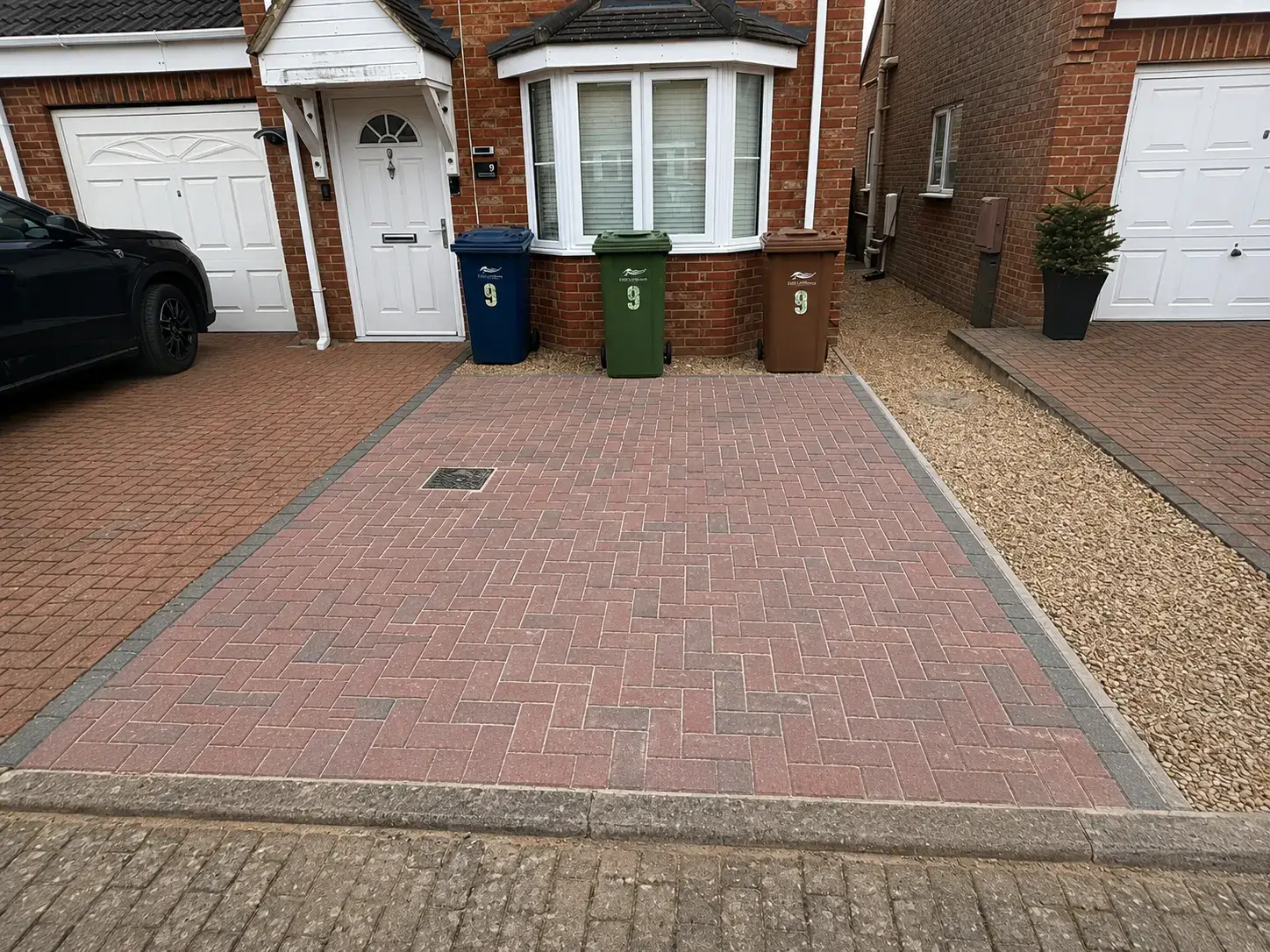
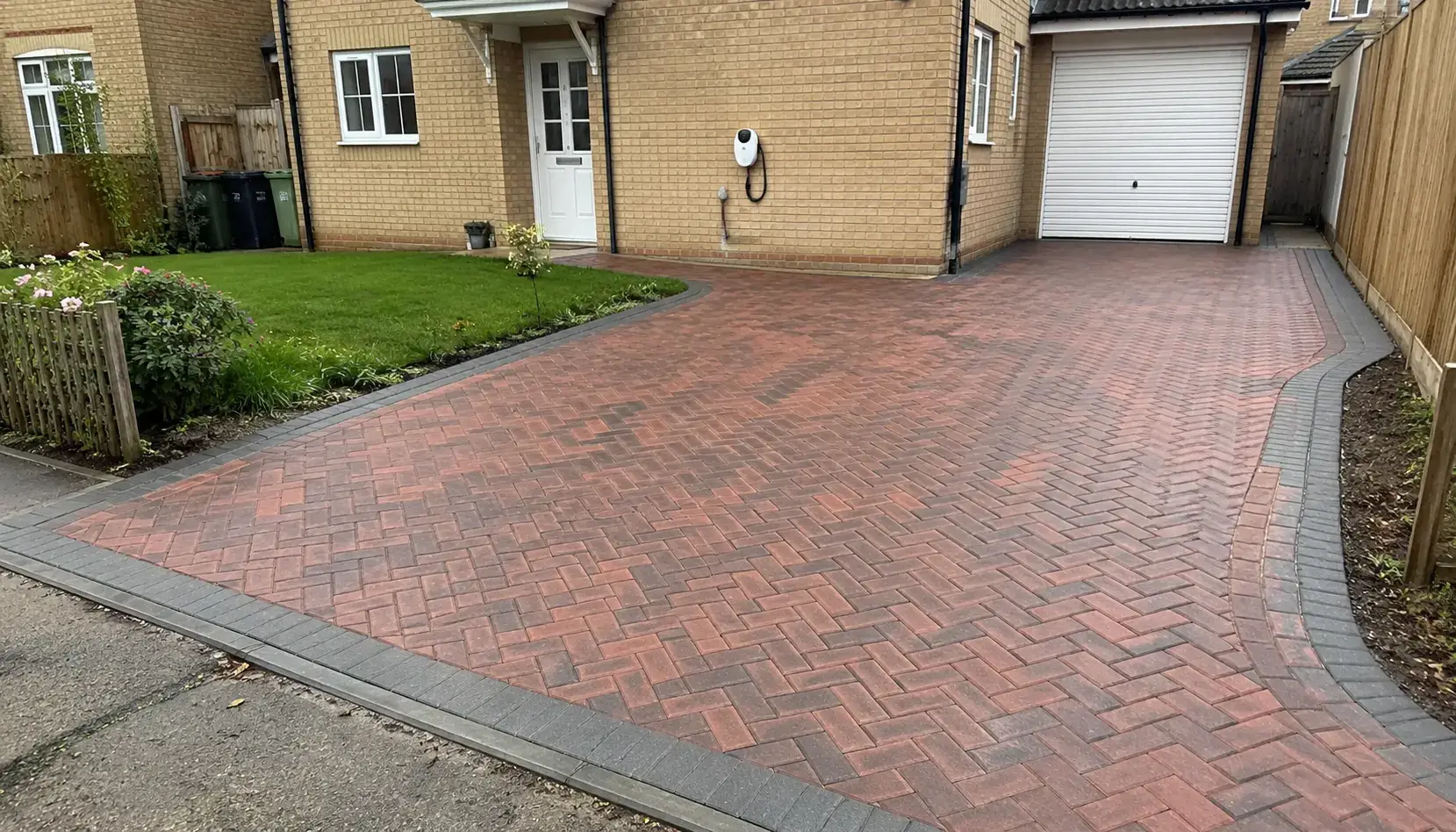
Laying the blocks. Time to put the blocks down. For driveways we mostly use a 45° herringbone pattern, following the standard setting-out method to keep the chevrons running parallel to the house and the cuts clean at the perimeter. We use a block splitter and a diamond-tipped blade for the edging, so you won’t see untidy gaps where the paving meets the edge restraints.
Compaction and jointing. Once the blocks are laid, we use a plate compactor to press them down. A top layer of kiln dried sand is then swept into the joints. Then, we compact again so they sit as one unit.
Final inspection. Levels are checked and any drainage fall in place and the driveway is ready for use. Offcuts, tools, dust, you won’t see any traces of this project once we’re done.
A typical driveway takes between three and five days to complete. Champion Construction is a family run business, managed by Danny and his son. You won’t deal with call centres and will never be left on the project site with someone you’ve never met before.
When it comes to drainage, the Fenland area means that there is a higher water table and so drainage is especially important. We incorporate this into our quote and initial site measurements for any new driveway. If your existing driveway requires full replacement rather than repairs and resurfacing, we’ll make sure to inform you when you get a quote.
Want to find out more about what the process is like from start to finish for your home? Call Champion Construction today on 07443 843610 for a free quote.
The most common thing we hear when visiting a site in Ely is concerns about what needs to be considered when planning a new driveway in a front garden.
If you are considering paving over a front garden and the paving is over five square metres and non permeable, you will require planning permission from the local authority (East Cambridgeshire District Council). Since 2008 this has been part of national legislation. But what you might not know is that, if correctly installed and maintained, block paved driveways are not normally required to be given planning permission. When installing block pavers, the gaps are filled with kiln dried sand, allowing drainage to pass straight into the ground below. This means that the driveway is classed as permeable and you won’t need to apply for planning permission or wait weeks for an answer.
As I said, this is usually the number one question we are asked when we visit sites across Ely. Someone will have found something on Google and will be panicking about permits and planning permission, but it’s something we can reassure you within a five minute visit. There are a couple of key things that will affect the drainage of your driveway:
Drainage Rules and Planning Permission for Front Driveways
Joint width between the blocks, plus the type of sand employed;
Permeability or impermeability of the sub-base;The fall you require to the block paving to direct water away from the property;
Ground conditions, for instance, heavy clay is typical of the area around Stretham and throughout most of the Fens.
Clay soil is a regular feature of the area we work in around Cambridgeshire. This soil does not drain as quickly as we’d like. So we take that into consideration when planning the depth of the sub-base construction, and the drainage falls. In some jobs we might lay a channel drain across the bottom of the driveway to catch surface water before it gets to the pavement or your neighbour’s garden. Whatever the ground we’re building on throws at us, we’ll sort it.
If your property is listed, or situated in a Conservation area close to the Cathedral, then different planning rules may apply. We’ll let you know during the quote stage, so you’re aware of any possible additional costs and there are no unpleasant surprises. We’re Champion Construction, family-run by Danny and his son, so you’ll be in contact with the man who’ll actually be doing the work. Not someone reading from a script! If you have any concerns regarding drainage or planning permission, we’ll advise you over the phone on-site, free of charge.
Need help with your block paving driveway?
Get a free quote on your block paving driveway. Champion Construction Ltd is ready to help.
Selecting the Correct Block Type and Pattern to Suit Your Home
It’s around this stage when most of our customers start to hit a bit of a snag. So, you’ve decided on block paving, but now you’re left with hundreds of colour choices, shapes and laying patterns to choose from. No worries. We’ll talk you through what’s best for your home, budget and style requirements.
There’s far more to it than just choosing the right look. Choosing the correct block for the application is just as important as laying it properly. Most of the driveways we build for customers around the Ely area use 50mm or 60mm thick blocks. The 60mm is the block thickness we’d recommend for driveways which are going to be used with normal car traffic on a daily basis. Lighter gauge blocks are just fine for paths and patios, but a thinner block doesn’t have as many uses on driveways and will not hold up as well in the long term.
Popular Block Shapes, and When to Use Which
- Rectangular blocks are the most popular block shape. It can be employed in almost all laying patterns, it complements every home style; whether you’re renovating a terrace on Broad Street, or building a modern detached in Stretham.
- Tumbled blocks give a softer, aged finish, which is a cracking choice if you have a more characterful home and you want the new driveway to complement it.
- Driveway setts are smaller and chunkier blocks, which look perfect alongside edgings or borders, or can be used as a running feature through a larger area.
Then we come on to laying patterns. The herringbone pattern is what we lay for driveways. It bonds together as the blocks lock into each other under load, so the surface remains solid and there’s no moving around of individual blocks when a car drives over it. This is why Pavingexpert recommends a fully interlocked pattern for all driveways, with herringbone the most popular choice.The stretcher bond pattern looks good and works well for paths, but it doesn’t lock together and grip as effectively under the force of a car wheel turning in and out.
Ensuring Your Block Paving Endures East of England Winters
Ely experiences genuine winter conditions. There is frost, puddles, and extended periods of dreary, damp weather that frequently remains stubbornly wet. This combination is harsh on block paving, perhaps more so than many homeowners anticipate.
We’ve seen block paving cope admirably with such weather, provided it was constructed correctly from the outset. In reality, the greatest hazard isn’t the freezing temperatures; it is water sitting in undesirable locations. Trapped water beneath the surface expands as it freezes. This expansion raises blocks and erodes sand in the joints. Soon enough, that beautiful driveway can look as if it’s reached a decade old much sooner. We see this happening almost every year across Stretham, Littleport, and throughout the Fens.
Your Autumn To-Do List
Making a few simple preparations before November can prevent months of trouble. The advice we give most of our customers includes:
- Sweep leaves and debris off the paving regularly. This keeps water draining away through the joint sand instead of pooling on the surface.
- Check for any blocks that have lifted, dropped, or shifted. Sort these before the first frost, because once the ground freezes a small problem turns into a much bigger one.
- Top up the joint sand with kiln-dried sand where it’s needed, especially anywhere it washed out over the summer.
- Make sure the drains are clear and running freely, so water comes off the driveway and away from the house rather than back towards it.
This process does not take long, and the majority can be easily performed by yourself with a stiff broom and around 30 minutes on a dry Saturday.
We are aware of how the surrounding Ely landscape is characterised by heavy clay soils, which retain moisture extensively. For this reason, our standard practice involves laying a minimum 150mm sub-base. However, this may increase if the site and weather conditions warrant it. A sub-base thinner than 150mm would not be suitable for clay soils and would almost certainly lead to movement problems. This is actually the most common defect we are engaged to rectify in driveways laid by other contractors.
Should you observe blocks beginning to lift after a particularly harsh frost, do not despair. A straightforward driveway repair would suffice. We would simply lift the affected area, re-compact it, and replace the blocks. In most instances, this would be resolved within a day. However, if this is ignored the issue will worsen rapidly.
Need Advice?
As a family business owned and run by Danny and his son, we take pride in offering our local community personal and reliable service. If your block paving has endured tough conditions recently, please contact us on 07443 843610 for a free quote. We will visit your property, assess the situation, and recommend a practical and cost-effective solution that fits your needs.
Explore Our Other Patios Services
Resin Bound Driveways
A smooth, contemporary surface that's low-maintenance and fully permeable.
Frequently Asked Questions
Common questions about block paving driveways services in Ely